Research • Branding • Product Design
Interview Kickstart: Transforming fragmented job searching into a targeted, AI-driven career agent
Eliminating fragmented research from all over the internet by curating a list of relevant jobs that align with their skills, experience and expertise.
Time
2 weeks
Role
Product Designer
Collaborations
Product Manager, dvelopers, stakeholders

Context
Interview Kickstart empowers senior professionals to uplevel their skills and land dream roles at tier-1 tech companies. However, the pre-interview phase remains a major bottleneck for candidates.
Problem
• Fragmented Workflows: Candidates waste hours hopping between 45+ isolated job portals.
• The Alignment Gap: Vetting complex qualifications against ambiguous job descriptions causes decision fatigue and self-doubt.
• The ATS Black Box: Crafting a resume that parses perfectly without losing the nuance of senior-level experience is a constant, unguided guessing game.
• Building deep user trust: When a system automates matching and "upgrades" a resume behind the scenes, how do we design an interface that makes users feel completely in control and confident in the output?

User Research
To design a high-trust, automated ecosystem from the ground up, I initiated a multi-method research phase combining comparative market analysis with direct user validation. Because the product is in its pre-launch phase, this foundational discovery was critical to de-risking our UX hypotheses.
Competitive Landscapes: I conducted a deep-dive heuristic evaluation of dominant market players, including Teal, Jobscan, Careerflow.io, and Enhancv. I analysed their data-ingestion pipelines and resume optimisation flows to identify where users experienced friction, cognitive drop-off, or "AI skepticism."
Qualitative Syntheses: I cross-referenced broader industry pain points via LinkedIn professional communities and conducted targeted user interviews with mid-to-late career professionals.
Key Insights
While automated tools solve the issue of time efficiency, our research exposed a deeper psychological barrier: The Trust Gap. Experienced professionals are highly protective of their professional reputation and cautious about letting an algorithm manage their career progression.
Our discovery phase revealed three critical insights that pivoted our entire design strategy:
Users feel a profound lack of agency when an AI automatically parses their background. They fear that a machine cannot capture the nuance, scale, or context of their 10+ years of technical leadership.
When competitors force users into a complex, inline text editor to fix their resumes, cognitive load spikes, and the momentum of the job search stalls.
Senior candidates refuse to blindly apply with a resume they haven't vetted. If they cannot see exactly what changed during the "elevation" process, they reject the output out of fear it looks generic or inaccurate.
The Pivot: This research transformed my role from simply designing a functional job-search utility into architecting a high-trust, transparent career agent journey.
Design
With all the information gathered by user research and competitive benchmarking, I noted the specific problems I was designing to solve:
Fragmented Search Infrastructure: Users waste excessive time hopping between 45+ isolated job portals to find relevant openings.
The "Black Box" Anxiety: Senior candidates experience an immediate loss of agency and trust when automated systems parse their 10+ years of technical expertise without explanation.
The Manual Vetting Bottleneck: Mid-to-late career professionals must manually cross-reference their complex qualifications against ambiguous job descriptions, causing severe decision fatigue.
The ATS Compliance Gap: Candidates struggle to optimize their resumes for rigid ATS filters without losing the authentic nuance and scale of their leadership experience.
High-Friction Editing Tools: Competitor platforms often force users into complex inline resume text editors, which spikes cognitive load and stalls their job-search momentum.
Finally, I designed the following features to solve the above-mentioned problems:

Unified Job Intelligence Engine
An aggregated command center that pulls live openings from 45+ major job portals into a single interface, completely eliminating cross-portal fatigue.
Hyper-Targeted Role Alignment
A curated job feed tailored specifically to a candidate's distinct technical expertise and seniority level, along with a transparent job match score


Various ways to test your abilities against a job description
Test your capabilities against the listed job descriptions and apply directly or paste a job description by yourself and get an ATS aligned resume
ATS-Engineered Resume Delivery
A zero-friction value exchange that instantly provides a ready-to-use, structurally optimized copy built to seamlessly pass modern ATS filters.
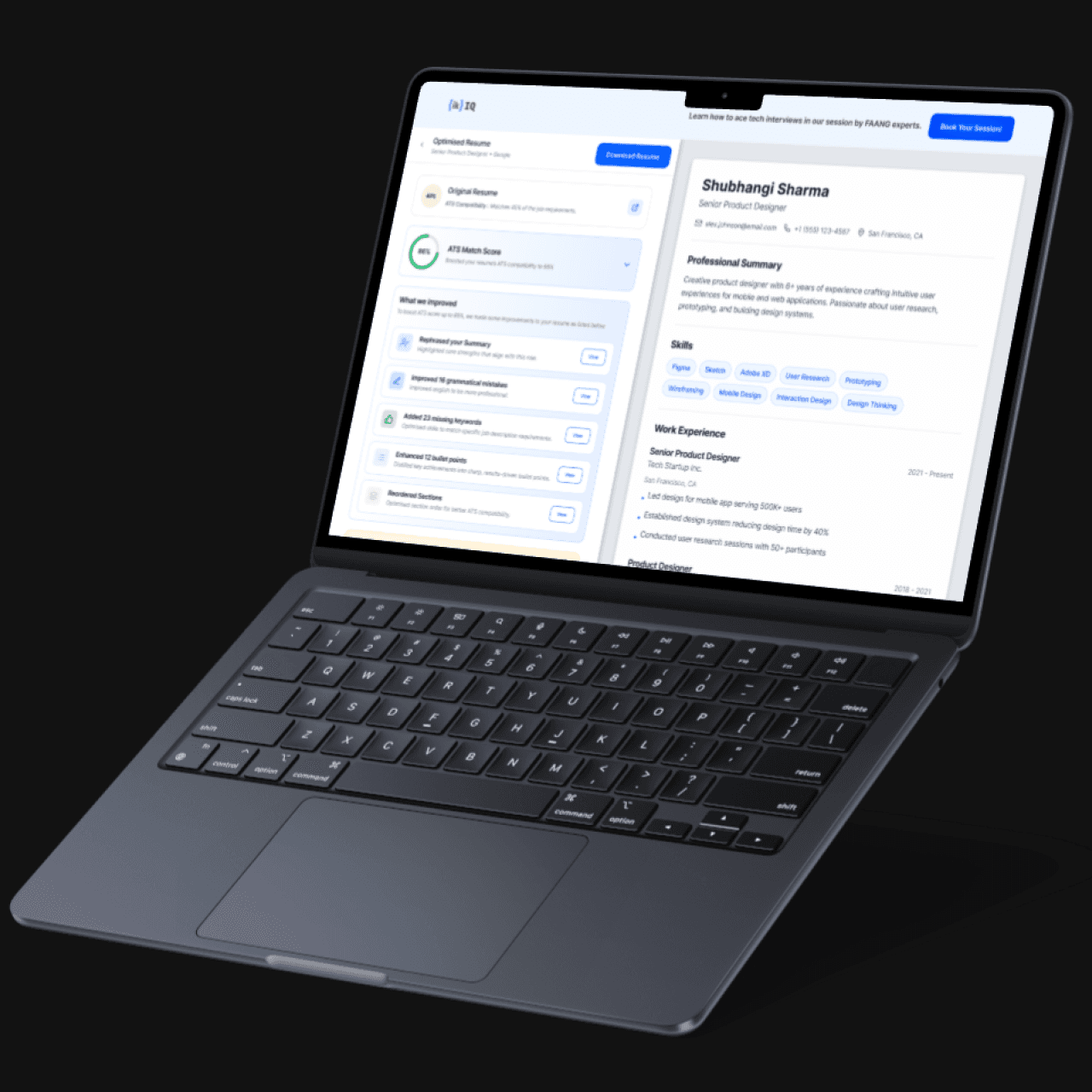
Contextual Resume Elevator
A dynamic optimization feature that instantly adapts a user's core profile and impact metrics to align with any specifically targeted job description.
Strategic Application Pro-Tips
Actionable, bite-sized insider guidance on referral hacks and high-yield submission strategies to convert applications into live interview loops.

The Outcomes
Increase in sales
84%
Expected to improve job search
40%
Increase in user trust in IK
25%
From behind the scenes
Designing a zero-to-one product required intense cross-functional negotiation and strategic trade-offs to de-risk our launch timeline. I collaborated closely with our backend and AI engineers to translate complex algorithmic data ingestion into a fast, transparent UI, utilising intentional skeleton states to manage background processing states seamlessly. Furthermore, I successfully advocated against building a heavy inline text editor for the MVP—saving weeks of development overhead and ruthlessly prioritising an intuitive, low-friction "Inspect & Download" flow. By pressure-testing these high-fidelity prototypes through feedback loops with our internal alumni network, we validated our core trust signals and interface clarity well before writing a single line of production code.
Project Takeaways
1. Trust is a Design Metric
When leveraging AI, user anxiety lives in the gaps where data is hidden. I learned that a high-performing algorithm is useless if the UI feels like a "black box." Designing explicit data breakdowns and clear "before-and-after" validation states is what ultimately bridges the gap between user skepticism and adoption.
2. Friction Isn't Always the Enemy
While product design usually prioritises absolute speed, senior professionals actually value a deliberate pace when it comes to their career assets. Adding a structured "Review & Vette" moment before download actually increased perceived value and user confidence—proving that intentional friction can occasionally build massive trust.
3. Lean Architecture Accelerates Speed-to-Market
Saying "no" to complex features (like an inline text editor) in favour of a frictionless, downloadable output taught me the value of ruthless prioritisation. As a product designer, my goal isn't just to design beautiful components, but to architect strategic MVPs that solve core customer pain points efficiently.


